Showing posts with label sea turtles. Show all posts

Monday, August 20, 2012

Local Research: Green Sea Turtles 101

photo by Kirsten Jones - beautiful shot taken in Boca Raton, FL
Many moons ago, a professor referred to the anemone as "charismatic macro fauna".  He was, and still is, a marine plant and algae guy.  Some animals are definitely more attractive to the general population of humans just as some species have a bad rap and strike fear in others.  I have close friends who freeze at the sight of a spider or snake, even if it is just a still photo or on television.  I have family members who do not venture into the ocean for fear of sharks (making my married last name even more ironic!) or jellyfish. There are also good friends in my circle who literally breed reptiles of all sizes, so I like to think of myself as being well rounded in my love/hate relationships with animal species.
    ...Except for scorpions. 
...Not cool with scorpions.

Sea turtles are certainly one of those creatures who have the "charisma" stated by my former instructor.  Today enjoy some background into the world of one particular sea turtle species.  This post does not give all the general information on sea turtles, their life cycles, and information of that sort.  I have decided today to be specific and give those who may already have a love for the marine turtle some knowledge that goes a little deeper.  Plus, at the end enjoy a BONUS!  I received such wonderful feedback about Jellyfish 101 and Evan Orellana's paper, that this time my friend and colleague Cody Mott has agreed to share some of his turtle research with us. Enjoy!

Green Sea Turtles 101:

Happy Birthday, little green turtle!
General consensus in the scientific community is there are seven different species of sea turtles: The Loggerhead, Leatherback, Hawksbill, Kemp's Ridley, Olive Ridley, Australian Flatback, and the Green. There is one noted sub-species to the Green known as the "Black" sea turtle if you really want to get technical.
Most of those species are found in Florida waters at some point in their life cycle, and today the focus is one particular species - the green sea turtle (Chelonia mydas).  Greens nest here in Florida, and are also found in local waters as juveniles, feeding on plants and grasses.  There is even a species known as "turtle grass" (Thalassia testudinum).  This last fact is especially cool when you look at the classification of the sea turtle:
Kingdom - Animalia (animals)
Phylum - Chordata (vertebrates)
Order - Testudines
So, the plant is quite literally named after turtles - even in Latin!
Why are they called "green" turtles? Especially as adults, green sea turtles are vegetarians, and just like a flamingo turns pink from eating shrimp, the body fat of these turtles is tinged green from all the plant consumption.  Cool.   Ew.   No... Cool.

Where do they nest?  Green sea turtles are found all over the world, partly in fact due to their migration routes that expand for tens of thousands of miles.  The "long road home" takes on a whole new meaning as this species, along with all other marine turtles, swim back after nearly 30 years to the original beach of their birth.  Florida happens to be a nesting hot spot and considering this species has had some serious downs (endangered status) along with great research and conservation efforts, nesting is back on the rise.  While an individual turtles may nest as many as 5 times in one season, that takes such a toll on the animal that she doesn't return to the beach the following year.  That means a bi-annual pattern of high and low nesting seasons for greens has developed.  Plus, with that really long swim mentioned earlier, just trying to get back every single year to nest would be extremely difficult.

Green turtle track with a distinct tail drag down the middle
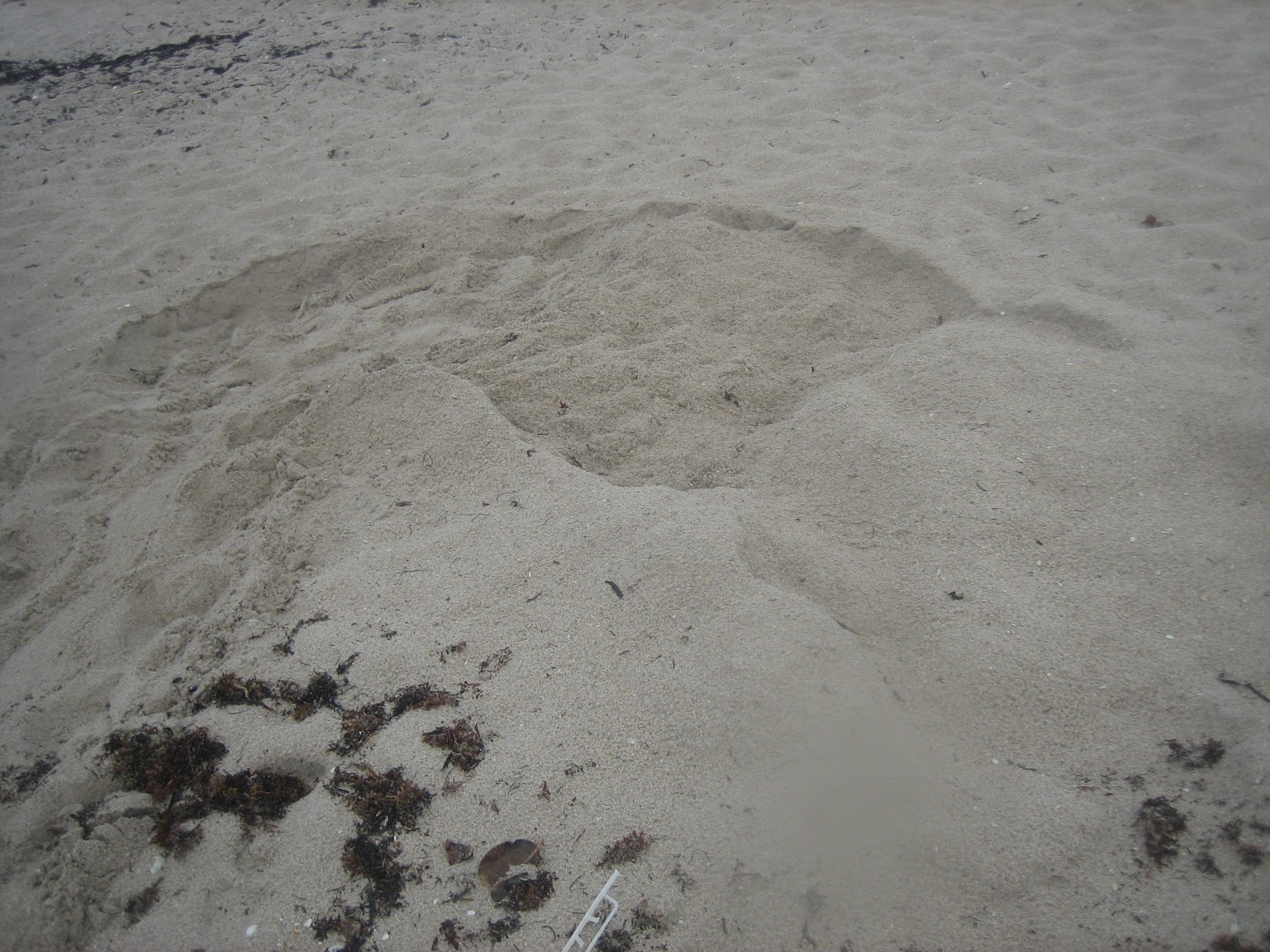
These ladies seem make HUGE nests with deep body pits, and often work their way well into the dune vegetation.  A variety of theories are out there as to why this occurs, including that turtle-momma might be nesting as far from the high tide line as possible to avoid her nest washing away during its 60+ day incubation.  Here in Florida, though, when up in the dune vegetation beware of FIRE ANTS. These invasive insects have been regularly documented killing hatchlings (baby turtles) by swarming nests.

Big turtle = BIG PIT
During my years of nesting surveys, I found green turtles occasionally spend so much time nesting (digging, laying eggs, and covering the evidence) that they were still on the beach after dawn.  This also led to me learning exactly how far those flippers actually spray sand while covering their nest.  I stood behind the lovely female below only to be knocked over by the sand blast!
The 3 stakes in front of this turtle mark a loggerhead nest laid that same night. The tracks from that nest are still visible.
Similar to loggerheads and hawksbills, green turtle eggs are roughly the size of a ping pong ball. Green nests are usually larger though, which makes sense as this is a much larger species of turtle. The average green turtle nest has 120 - 150 eggs, with my personal highest count being 174 eggs in one nest.

How big do greens get?  This particular species of turtle can easily grow anywhere from 250 - 400 lbs (110 - 190kg) on average. The largest green turtle documented was 5' long and 870 lbs.


How to identify a green from another species:  Green sea turtles are distinct in a few ways. When looking head-on, there is only one pair (i.e. 2 total) scales between the eyes. Most turtle species have two pair in that location.
The 2 Pre-frontal scales between the eyes are unique to green sea turtles
When looking at the carapace, or top shell, greens have four scutes on each side, and five down the middle.  Their shells may vary in color from green to yellow.  Their shells are usually clean, especially compared to loggerhead turtles; they are even documented on reefs at "cleaning stations" where fish or other symbiotic critters come out to help keep the turtle looking shiny.  Picture the "car wash" in the movie A Shark's Tale and you will get the basic, albeit far more musical, concept.

Juvenile Green Turtle - Carapace View
Green sea turtles are on the rise, but were once a critically endangered species here and in other parts of the world.  Why?  Think about it... this animal is named after the color of its meat.  That would be like referring to cows as "red" cattle.  Humans ate them, and in some areas and cultures still do.  The Cayman Turtle Farm in the Cayman Islands participates both in research and restaurants.  Sea turtles are a part of the lifestyle there; while I have never (and doubt I ever could) eaten turtle of any kind, I do have to slow down and understand that my culture is not the same for everyone.  I do eat meat.  Some humans have chosen a life as a vegetarian or even gone a step further as purist vegan.  No judgement, except on to-fur-key.  If you have never heard of it, good for you. Sorry, vegans. But I digress...
Turtle canneries went out of business long before sea turtles were added to the endangered species list in 1978.  This was due to overfishing practices.  Research and conservation efforts have been in full swing almost ever since.  The point is humans should take responsibility and always tackle feeding our race while keeping sustainability in mind.
Ouch! (I just twisted my ankle jumping off the soap box)

If there is some burning question you have about greens or any sea turtle species, feel free to ask! I'll be happy to share what I know as fact, or else I will find the right answer for you!

BONUS ROUND!

I consider myself lucky to have acquired many wonderful friends and colleagues over the years, and Cody Mott is no exception.  I have the honor of bragging that I knew him before completing his Bachelor's and Master's degrees, before his work at Inwater Research, and now even before his marriage to another awesome friend- Rebecca.  Cody's Master's thesis focused on one behavioral aspect of the green sea turtle.  While all sea turtles must orient themselves to reach the ocean as hatchlings, animals with large migration routes must also be capable of finding their way through a multitude of habitats without getting lost.  Cody worked closely with one aspect of green turtles and their ability to find direction using the sun as a compass.  Many of the behavioral studies on sea turtles focuses on the green.  This is because the general consensus among those working with marine turtles on a regular basis is that the green is the most intelligent among the lot.  They are usually the ones trained first in captive settings and personally, I find them the prettiest (sorry, hawksbills).  I am also aware that the last fact is completely unrelated, but thought you should know anyway!
Don't those eyes look intelligent to you?


Sun Compass Orientation in Juvenile Green Sea Turtles (Chelonia mydas)
CODY R. MOTT and MICHAEL SALMON
Department of Biological Sciences, Florida Atlantic University, Boca Raton, Florida 33431 USA
[codyrmott@hotmail.com; salmon@fau.edu]


ABSTRACT. – Juvenile green turtles occupy home ranges on shallow reefs that parallel the
southeastern coast of Florida. When disturbed, the turtles often flee eastward toward deeper water. We captured turtles at night and recorded their orientation during the next 2 days while they swam tethered inside a large circular outdoor pool and were exposed to the sun. The turtles from 2 reef sites were significantly oriented eastward. After 7–10 days of exposure to a laboratory photocycle advanced by 7 hours, turtles tested in the same pool were significantly oriented westward, the predicted direction if they used the sun for orientation. Westward orientation was unaffected by placing either disc magnets or brass discs of identical mass above the turtles’ heads. These results are consistent with the hypothesis that orientation under clear skies is preferentially based upon solar cues. However, control turtles exposed for 7–10 days to a photocycle advanced by 1 hour were also expected to swim generally eastward, but, for unknown reasons, failed to show significant orientation. Our results therefore support the hypothesis that the sun is used as a compass, but additional experiments will be required to provide definitive evidence.


To learn more about Cody's research, or to acquire the complete paper, contact him directly or contact myself through this blog and I will be happy to help.  He now works with a fantastic organization called Inwater Research Group. To learn more about their (and Cody's) current work, check out the website: http://www.inwater.org.

For general facts about sea turtles, to learn more about the conservation and research going on throughout the entire world, I highly recommend the following sites:
http://www.seaturtle.org/ or http://www.conserveturtles.org/ The latter was formerly the Caribbean Conservation Corporation and is most useful when looking into research done in that region of the world.  I hope this post has helped you get to know and love one of my favorite species just a little bit more!

Just keep swimming!
-Callie Sharkey

Sunday, July 22, 2012

Back on Turtle Beach


Like most Florida residents, I moved here from somewhere else - somewhere quite different. I didn't come here for the endless summer, but the sand and saltwater were directly related to my pilgrimage from the heart of the Bible belt to the east coast, the crust of the New World and the beginning of mine.

As a kid I was in awe of Shamu and inspired by every bleached out sea star in the gift shops of Hawaii.  I was fortunate enough to go there as an enthusiastic 11 yr old and nearly went blind on that 2 week trip, staring at the ocean horizon; not daring to blink lest I miss a humpback whale sighting. Even then I knew that April was past season and their migration to the cold waters of Alaska had already begun-  they were long gone.  Still, I stared endlessly and used my allowance money to buy a t-shirt with a very friendly sunglass-wearing humpback cheerfully displaying the false impression that I had actually seen a whale for myself 

Florida, despite its lack of humpback whales, was still the ocean and I jumped at the chance to move over 1500 miles from everyone and everything I knew just to be near it.  Following one opportunity to the next landed me working on the beach doing sea turtle research. This immersion commanded my attention both professionally and recreationally for nearly 10 years.  From nesting to rehabilitation, through live capture and necropsies on the dead, sea turtles has been so integrated in my life that I can honestly say, "been there, done that, got the tattoo." 

Last week I found myself back on the beach recently with another college buddy, Donna.  Scheduling conflicts and a toddler kept me off sea turtle nesting surveys (this year) but I was able to capture this moment and remember why I love the world of turtles and find the process of nesting surveys on the beach so restorative.  As an educator, it would be easy to carry on about sea turtles indefinitely, and anyone who has known me for more than 5 minutes would probably attest to that fact.  There will be more on turtles in the future on this pages, but today I want to talk about one day and one survey.

Sea turtles live in the ocean. That might seem like a silly thing to mention, but I have seen people trying to raise them in chlorinated swimming pools and release poor freshwater sliders on the beach.  Marine turtles have such rare contact with land that it can be pinpointed to just a few reasons:


Perfect loggerhead nest fresh from the previous night
1. They are born on the beach, but immediately go to the water if healthy
2.  Females return as close as possible to the beach of their birth to lay their own eggs
3.  Unfortunate turtles wash ashore when injured or seriously ill
4.  There are always exemptions found in nature. For instance, green sea turtles, both male and female, have been documented basking on the rocky shores in areas of Hawaii. Have NOT seen that on my excursions to the islands, but have seen plenty of pictures and spoken to scientists and witnesses about it.


Sea turtle nesting surveys require permitting, training, and getting dirty.  Since marine turtles are all protected by the Endangered Species Act, not just anyone can go running out on the beach at dawn and go digging around. The survey consists of 3 major situations: nests, false crawls (aka non-nesting emergence if you want to sound technical), and hatch outs.  The last involves the end of incubation when live hatchlings (baby turtles) emerge from the nest and head for the water. This particular survey did not have any new hatch outs.

Donna and I arrived on the beach prior to sunrise, but when the sun finally started to peek out from the clouds we had already been walking and rained on for awhile.  Years ago, prior to becoming pregnant with my now 3 yr old son, I dragged my "I am SO not a morning person" friend out on to a totally different beach at dawn to volunteer on a 2 mile stretch not far from this day's survey.  While walking along we chatted lightly about turtle work in the past and how our lives have shifted, yet here we are again, back on the beach tracking the trails left behind by living dinosaurs.  Awesome.  It was almost surreal this time, though, as she was the lead on this survey, instructing me on how this beach is run. The methods and tracking vary with permit, and it was very cool to be trained by someone that I had trained in the past.  Then Donna said perhaps the greatest compliment I have heard this year... she thanked me for introducing her to sea turtles.

Just like me, D finds the long beach walks cathartic and prime time for self-reflection.  Since conservation work is happening at the same time, one often walks away from the beach feeling productive on a professional and emotional level.  C'mon, it's such a great feeling to know you are doing something for the greater good of the planet and pardon my lofty enthusiasm, but saving the world one species at a time also provides those warm fuzzies which drive humans to do many great things.
This False Crawl is a direct result of the turtle hitting a large sea wall.
Okay, the warm fuzzies have officially cooled off and now here are some real facts about sea turtles for you to enjoy!  Of the 7 species of sea turtles found on this planet (many scientists discuss an 8th, the black sea turtle but that is a discussion that merits its own entry - so I am going with tradition and the Sea Turtle Conservancy on this one), 5 are found in or around Florida's coasts and 3 of those have significant nesting here: loggerhead (Caretta caretta), green (Chelonia mydas), and leatherback (Dermochelys coriacia). 


Textbook green sea turtle track

In Florida, the turtle nesting season technically runs from March 1 - Oct 31, but the height of season is June 1 - August 31. Donna and I were greeted by both loggerhead and green turtle crawls on this day.
Loggerhead crawls are characterized by comma-shaped tracks
Any time a sea turtle comes ashore and does not nest, it is considered a false crawl or non-nesting emergence and can happen for a variety of reasons. Something may have startled the turtle (human or otherwise), or maybe she just digs for a bit and simply doesn't like the quality of the sand and changes her mind - a woman's prerogative after all.

Green turtle tracks look very similar to large tractor tire tracks (see above) and generally range from about 3-4' across.  These mature ladies start at 300 lbs, so they are using all 4 flippers to hoist their bodies up the sand  The center line seen in the photo I took on this survey shows the tail dragging in the sand as she moved back to the water.

Loggerhead turtles are smaller and crawl very differently.  They have an alternating gate, like how human babies typically crawl around with one limb forward at a time.  The comma-shaped flipper marks are made by the back flippers, so the track pictured here is moving to the left. The back flipper track basically covers up the front track, which makes it easy to spot a "stumpy" turtle - one with a short or missing back flipper.  It happens, and while the egg chamber may look odd, these injured turtles can still have successful nests.
This loggerhead nested right next to a large stack of folding beach chairs, so we tri-staked the area to keep it from getting consistently trampled for the next 2 months.
In addition to marking new nests and taking notes of false crawls, we were keeping an eye out for hatched nests.  Roughly 60 days after the nest is laid, all of the eggs hatch and the baby turtles emerge from the nest as a group. This usually happens at night, so a mass of tangled tiny track marks can be seen the following day.  I do not suggest sitting next to a nest all night long exactly 60 days after it was laid in the hopes of seeing a natural hatch out.  I have personally spoken to people who had "been walking this beach for 40 years" and never seen one, and also a family from Indiana that had arrived the previous night/morning on a red eye flight, checked in to their hotel and walked out on to the beach to see the little critters everywhere.  It's like roulette, and all about luck.
I never get tired of beach work!... although I do smell pretty bad when I get home

Part of the survey includes excavations.  Digging up a hatched out nest yields extremely valuable scientific data. Loggerhead nests (what we dug this time) are usually about 2 feet deep overall and shaped like an upside down light bulb.  The hatchlings move around in the bowl portion and since you have 75 - 100 of them moving around down there, the sand packed into the shaft by momma breaks away and filters down under the babies.  This process slowly pushes everybody up in one chaotic group, but sometimes the dudes at the bottom of the pile get left behind, but don't worry - we find 'em later and set them free after taking complete inventory of the nest contents.
Excavation & inventory take place 3 days after hatch out to allow nature to take its own course
We finished the morning after 3+ hours with 3 loggerhead nests, 1 green nest, and a couple of loggerhead false crawls. We excavated 2 loggerhead nests, and ended up with 7 live guys that all went to the ocean quickly. Not a crazy day considering this is a record nesting season for loggerhead turtles across the state, but no nests washed away, no poaching, and no natural predators destroying nests so I would still call it a productive and positive day for turtles.

Happy Birthday! to this little loggerhead hatchling
Since my passion for sea turtles does run so deep, expect to see plenty of photos from past excursions emerge on to the blog.  Going back out for one morning reminded me of how amazing the experiences have been, and that I documented so many of them with photos and videos!

Even if its raining, don't be afraid to go to the beach.  At least it won't be crowded! (now, lightning is a different story and use that big beautiful brain of yours when it comes to playing safe) Dig through those old photos and take a moment to reminisce about those adventures that truly shaped your life.

And, if you aren't sick of sea turtles yet... stay tuned!
-Callie

Monday, June 25, 2012

Gumbo Limbo Nature Center - Revisited

There are so many local parks and wonderful places to visit on your own or with family.  One place quite near and dear to my heart is the Gumbo Limbo Nature Center in Boca Raton, FL.  This FREE facility stays open with support of grants, public donations, the City of Boca Raton, and Florida Atlantic University.  This facility has been around for nearly 30 years as a resource for educational programs, all the while instilling a love for many natural local treasures - sea turtles being perhaps my personal favorite. My history with Gumbo Limbo reaches back into the previous millennium, and I can honestly say it was the catalyst for changing my life.

As a teenager, my mind (as all teenagers do) was set in concrete: I was joining the United States Air Force. Instead of taking art classes or home economics, I attended a technical school and was trained as an aircraft mechanic. I finished entrance exams and a battery of tests. I got my letters of recommendation and worked at a small local airport for a flight school and FBO.  I was a female in a non-traditional field and reasonably good at my job.  But I yearned for the water even more than the sky.

Further back in time, as a child, we traveled to both coasts visiting family, and I shall never forget when I was only 5 years old and saw the ocean for the first time. The Jersey Shore was grey and cold but I believed it to be the most beautiful site on the planet.  I was chased by ridiculously brazen and monstrously huge sea gulls who in the end did, in fact, secure my glazed donut. So yeah, I was both traumatized and simultaneously hooked on the ocean, although less enthusiastic about gulls.

My life slowly unfolded, choices were made, and I landed in south Florida many moons ago.  After about a year of dealing with the culture shock, I took the scenic way home one day and saw the Gumbo Limbo Environmental Complex on Ocean Boulevard; at that moment my new direction in life was set in motion. I walked in just to check the place out and was so inspired that I knew instantly I wanted to volunteer there. Coincidence had me meeting with the volunteer coordinator at the front door, and within a week I was going through my volunteer orientation.  So many volunteers and staff there were in college, that within another week I was enrolling myself in hopes of acquiring that impossible degree in marine biology.  Gumbo Limbo provided mentors, close friends, and field experience that I had never seriously imagined possible. When I try to define "home", Gumbo is still one of the places that comes to mind and I go there even now for inspiration and reflection.

Growth is a part of life, and Gumbo Limbo has never stopped evolving.  The facility has practically been through an overhaul in the past 5 years alone.  Now, I go back and usually take my 3 yr old son to explore.  The first stop out front is the Sea Turtle Garden, where all 7 species of sea turtles are on display as life size replicas. Since of course one should never actually climb on or harass a sea turtle, this is the perfect opportunity to get a "feel" for the scale and presence of these living dinosaurs.  The artist's renditions of these animals is meticulous and anatomically accurate too. My little one was not the only person scaling these sculptures that day, I assure you! It was actually quite tricky to get this photo without showing people all over the place.
The Sea Turtle Garden is a great spot to be a kid again!
Among the major changes going on, Gumbo completely renovated one of the most popular exhibits- the large, open water system aquaria.  These tanks hold thousands of gallons of seawater pumped in directly from the ocean.  The "open system" has water quality literally as good as the ocean's and the drain flows into the intracoastal waterway behind the facility.  It actually improves the water quality in the intracoastal too. This unique snapshot of Floridan ecosystems reaches from the shallow mangrove community to the coral reefs, and examples of these are shown with beautiful style.
The mangrove exhibit is actually 2 separate aquaria (only 1 shown here)
One striking contrast of these new tanks is that they are covered! I recall countless hours sitting under mesh canopies getting drizzled on while speaking with guests determined to squeeze every moment of fun out of their limited vacation time. Both the sun and elements are now removed and the focus is truly on the exhibit itself and the animal ambassador residents.  The deeper tanks actually have two different viewing levels, and we came so early after the re-opening of the exhibits, that we did not get a chance to see the puffer fish and sharks from the upper deck. Just a great excuse to go back soon!

A visit to Gumbo Limbo is incomplete without taking the time to enjoy the historical side of the facility too. My son's personal favorites (this time) included the original cannons and the ship's wheel seen below.
Ready to set sail!
There are so many niches and interesting corners of the Nature Center, that to not explore in all directions is to miss some intimate moment that might stick in your mind.  The butterfly garden is nicely groomed and on the way down a pleasant trail leading to the intracoastal.  The opposite direction lets you roam through the ancient hammock. I can actually call it that accurately since the Indian midden mounds studied on site were dated back over 2,000 years! Take the time to climb the tower and get a view that would make a pelican jealous. Notice how the sounds of humanity fade away and tap into the natural environment without having to watch out for fire ants. There is more to see than what I mentioned here, but I will let you have a few discoveries too.

Above all else, know that every staff member and volunteer, much like myself, are permanently attached to this place. Gumbo Limbo is special to many lovers of nature, and allows for a unique and intimate experience for the general public of all backgrounds and interests.  The people answering the phones, feeding the fish, and providing educational enrichment truly love being there.  It shows.  Gumbo Limbo is not a franchise or a formula, but has grown into a local icon that should definitely be circled when planning your vacation, or even just a weekend.

If you went there as a kid on a school field trip, go back! Enjoy it on your own as a chance to reflect, or take family and rediscover it through their eyes.   As for me, I am always happy to go home and visit.  Besides, it is right next to the beach and you were headed there anyway - right?
-Callie

For more information on Gumbo Limbo, check out their website www.gumbolimbo.org