Showing posts with label research. Show all posts

Saturday, September 29, 2012

Invasive Species 101: Lionfish in Local Waters

Lionfish, Pterois volitans and Ptrois miles found very far from their native home
There are waves and trends that flow through every field from fashion to education.  Those particular two divisions melded together for me about 10 years ago when I bought a t-shirt that simply read "Green is the New Black".  Think about health food trends: oat bran, wheat bran, no carbs, vegetarian friendly - as our worldwide culture constantly evolves, there is also regular shifting among conservation efforts too.
The new eco-based 3 R's: Reduce, Reuse, Recycle

Once upon a time, recycling was depicted as a homeless person in the big metropolis pushing a shopping cart around and digging through trash in search of valuable glass bottles or aluminum cans.  Now theme parks with large mouse ears on everything boast recycling bins throughout the park, conveniently located right next to standard trash bins.  Small children in school are learning a very different 3 R's than our grandparents did: Reduce, Reuse, Recycle.  From experience I know that kids are getting that phrase hammered into their brains at a very early age; but do they really understand what it means and how to implement these changes in their everyday lives?  Eh, maybe / maybe not.

A few years ago, the theme of plastic tailgated the recycling party. While this is still an extremely important issue across the globe, as Heidi states in every episode of Project Runway, "One day you're in, and the next day you're out."  I watched the next trend and was very much involved in sharing the message of "Water".  Water is a limited resource and far more valuable than any fossil fuel, but just wasn't getting the attention deserved.  Too many people living in "civilized" areas were, and still are, taking water for granted.  Living in a state which suffers serious droughts and water restrictions most years has taught me how little human beings understand water as a limited commodity.  Florida might be surrounded by water, but it is undrinkable and would kill most plants. That particular concept I took on as personal challenge to teach to as many children as possible.  Kids simply don't often ask questions like: Where does water come from? Where does it go when I am done with it? What would happen if the water ran out?

These questions are just as important as recycling and global warming, plus all of those issues are integrated on a very tightly knit little blue planet.  In fashion, by the time a style or article of clothing makes it to the shopping mall, it is time for the industry to move on; otherwise, it wouldn't be cutting edge, right?  So, now that the plight of water has made it onto to episodes of Super Why (popular toddler's educational cartoon about reading/spelling on PBS and Sprout networks) and even become the main topic for the Girl Scouts of America's Brownie level Journey: Wonders of Water (W.O.W.), I look ahead and feel comfortable predicting the next new eco-friendly trend. By the way, I did also predict the water trend - so it helps my confidence in calling out the next play.

So what is the latest environmental impact that YOU should know about to remain cutting edge on the eco-front?

INVASIVE SPECIES
 
Now, I would never throw a pitch without teaching you how to swing, so get you ready for the next wave of conservation efforts that are already in place despite not always making the media headlines.  Here is the 101 needed for understanding invasives.

First, a few foundation terms that it never hurts to properly define:
"Species" means a group of organisms all of which have a high degree of physical and genetic similarity, generally interbreed only among themselves, and show persistent differences from members of allied groups of organisms."
"Native species" means, with respect to a particular ecosystem, a species that, other than as a result of an introduction, historically occurred or currently occurs in that ecosystem."
"Invasive species" means an alien species whose introduction does or is likely to cause economic or environmental harm or harm to human health."

Let's start by looking at these terms.  Basically, a "native" means this organism has always been found in a region naturally.  There is a term often used interchangeably and inaccurately with "invasive" and that is "exotic".  An exotic species is not necessarily an invasive species.  One escaped pet lemur roaming around the neighborhood is simply an exotic animal on the loose.  It will not establish a breeding population all by itself, and will not cause any large scale or long term negative impacts to the ecosystem where it is wandering around.

An invasive species is much different.  It has adapted to the environment and is breeding.  By adding an entirely new population to an ecosystem, now there is the threat of serious, detrimental impact.

Look back in the archives to "Jellyfish 101" to see my first mention of an invasive species in local waters - the Tripedalia cystophora box jelly (July 2012).  Invasive plants and animals are an issue every time explorers set foot on new lands, so this is not a new problem.  The United States Department of Agriculture even has an Invasive Species Council that was established back in 1999 to take on the arguably impossible task of tracking and stopping invasives from establishing themselves.

Most of the invasive species to an area don't get attention because they are organisms like non-toxic plants or critters low on the food chain. An invasive plant that does not sting like Africanized bees or eat your small dog as a large boa constrictor might simply do not garner extensive media coverage. Take a very short walk anywhere in Florida and several lizard species will be darting out of the way - none of them are native save for the small green anole and the bluish black skink. But since they do not grow to the impressive 4' and up of an iguana, most people do not see them as a problem even though many tinier animals are now at risk of endangerment and extinction due to the uninvited reptiles' presence.

So how exactly does a species go from being simply an exotic to an invasive?
  • Often these invaders become very successful predators. This concept does not exclude plants.  Many vines and shrubs will move into an area and choke out the previous residents. (i.e. Brazilian pepper, Schinus terebinthifolius). The Australian Pine (Casuarina sp.) sheds needles with a high acidic content, and over time the soil below the tree itself becomes too acidic for much of the local fauna to grow.
  • Generally, the local wildlife does not see this new inhabitant as either threat or food.  So potential predators overlook the new food source, and instead the population booms.
  • Invasives breed successfully, and often.
  • Natural processes do not apply to an invasive species
To better explain, I will use a marine invader that is adapting so quickly and efficiently, researchers and conservationist are pulling out all the stops to get the public on board and involved in this local eco-war: Lionfish.
 
A very successful predator on local reefs is the schoolmaster snapper (pictured above).  The bait in this particular predator/prey relationship are small grunts.  This photos shows clearly how the prey recognizes its predator and swims around the snapper, staying out just out of striking distance.


Grunts in the same area on a similar reef behave in a completely different manner with the lionfish.  While many of the fish in the photo above could be eaten, they pay no attention to the predator in their midst.  This allows for the lionfish to essentially gorge themselves on a regular basis.  Study of stomach contents has shown lionfish will eat around 80% of the animals found on reefs, including crabs, shrimp, and fish species.  They can also consume an animal almost 1/2 their own size in one big gulp.

Where are lionfish native?  The Indo-Pacific region:

How did they get halfway across the planet? These bottom dwelling fish are not the type to migrate into open water, and certainly not across long distances.  So, like every other invasive, they are introduced to an area.  Lionfish are an extremely popular decorative aquarium fish.  I have personally spoken to dozens of people who kept them and soon realized that the other tank residents were disappearing, until only the lionfish and anything too big for it to eat remained.

An invasive species may arrive in the form of pets that are released often enough to find mates and breed, but sometimes an exotic species is intentionally released into an area.  It is now considered a last resort effort to control a destructive invader by introducing its natural predator.  The cliche goes "two wrongs don't make a right", but nobody was thinking that clearly when the mongoose was introduced to Hawaii.  Rats became rampant when the islands were originally discovered, as there are no native snakes or other rat predators in Hawaii.  To tackle this problem, the mongoose was introduced... but rats come out primarily at night, and the mongoose is a diurnal day hunter... anyone else see the problem?  So now essentially Hawaii has both a rat issue and a mongoose dilemma. Nice.

Back to the lionfish.  These fish are commonly thought to be poisonous, but the proper term is venomous.  Use this adage:
"Poison is ingested, Venom is injected"
The lionfish meat is not toxic, and very yummy (personal experience talking).  The venom of a lionfish is only found in the spines along the dorsal (back) and ventral (belly/anal) of the fish, meaning those beautiful flowery pectoral fins and tail plumage are harmless (also personal experience).  These barbs work on a pressure puncture system, meaning that touching the sides of these needles will not sting.  That does NOT mean I suggest trying this out on a live lionfish just for kicks - actually that is a really bad idea.  While there have been no reported deaths due to lionfish stings, the venom is still very painful and any lionfish victims should go to the hospital for treatment.  There is always a chance of allergic reaction, so take precautions if tagged.

Available online & with local vendors
Researchers with Florida International University, the Loxahatchee River District, REEF, and Martin County are just a few of the amazing organizations working in different regions of Florida alone - but they are all tied together and focused on the same goal: lionfish removal from the natural ecosystem.  These Lionfish Derbies are working hard to get the word out the lionfish are edible to humans!  Because let's face it, humans have proven themselves to be excellent predators particularly in the oceans.

This book also includes how to safely clean a lionfish, but there are also tutorial videos out there for free.  Instead of providing a long list of great organizations involved in the valiant effort of lionfish removal, instead I shall focus on some of the lionfish biology that is less known and very important to understanding why they have become such a successful example of an invasive species.

A strong invasive species population breeds early and often.  While lionfish are becoming rare in their own native habitats, the explosion of inhabitants locally has also provided a plethora of biological specimens for scientist to study.  We have learned that lionfish breed when reaching a length of only 4" for males and 7" for females; considering these relatives of the native scorpionfish can grow to a record length of 18" and have been found all too often in the 15-17" range, that is an opportunity for exponential population growth.

When the zebra mussel was introduced into the Great Lakes back in the 1980's, the population expanded all the way south to the Gulf of Mexico.  This freshwater mussel cannot survive in saltwater, and this natural process is the only factor that truly stopped this invasive filter feeder's progress.  A great dynamic map of this migration can be tracked here: http://www.nationalatlas.gov/dynamic/dyn_zm.html

Natural barriers are often the deciding factor in the growth and success of an invasive species.  The jungle and heat loving iguanas found here will never reach into the states north of the Floridian border.  Cold snaps and even rarely freezing temperature put these endothermic animals into shock and they will quite literally fall out of trees from the cold.

So, lionfish live on saltwater reefs, and surely cannot breach the salinity gap - right?  Many estuaries, like the Loxahatchee River and Indian River Lagoon have brackish water that ebbs and flows with tidal influences.  This mixture of fresh and saltwater serves as a nursery for countless species in the area, and the further one paddles upstream the lower the salinity.  While the salt content in the water decreases, there are also changes to the species found.  Very few animals can withstand a full change from fresh to saltwater - snook is one popular local example.

A friend and associate with FIU, Zack Jud, has been working with the Loxahatchee River District (LRD) to track and study the lionfish population in the Loxahatchee River.  One scary development from an environmental standpoint is the discovery that every time the research crew goes further up river as part of the lionfish study and a long term Oyster Restoration Project (more about that study in a future post), lionfish are spotted.  The most recent sighting/sampling had researchers on the Loxahatchee shortly after a freshwater spike in the estuary due to rain and Tropical Storm Issac.  Lionfish have now been tracked 4 miles upriver into waters with a salinity of 8 ppt (parts per thousand).

Let me clarify this simple fact:  On average, ocean salinty ranges from about 32 - 37 ppt.  There can be extreme ranges like the Red Sea (42 ppt) and locations where freshwater and saltwater collide to lower the salinity, creating brackish ecosystems that eventually turn freshwater (0 ppt salinity).  As mentioned before, very few animals have the ability to adapt to this severe shift in salinity, so to find healthy lionfish so far upstream is disturbing.
Photo taken in the brackish waters of the Loxahatchee River, on one of the Oyster Restoration Project research sites.
Courtesy of Zack, here is the abstract from the original publication on the invasion of lionfish in the Loxahatchee River ecosystem:
 
Their initial discoveries immediately prompted more research, particularly to find out how fast these animals are migrating as a population, if at all.  This is the most recent published work in the Journal of Experimental Marine Biology and Ecology following up on the lionfish data regularly collected in the same area. Soon to be "Dr." Zack Jud and Dr. Craig Layman authored this particular paper as well.

Essentially, individual lionfish don't stray too far from home, showing a fairly strong inclination for "site fidelity".  Hey, if there is food here, why move?  Makes enough sense.  But, going back to the topic of successful breeding, larval lionfish will float in ocean (or in this case river) currents for around 30 days before settling in an area.  That fact will quickly compensate for any lack of migration from established individuals and keep the population growing and moving simultaneously - yikes!
Lionfish have since been documented 4 miles upriver.
So are invasive species a problem? Uh, yeah.  How are changes made to stop these earth-bound aliens from taking over?  Well, that is where everyone becomes an important part of the eco-puzzle.  Three major changes will have a huge positive impact:
  • Stronger regulations and enforcement on customs and international shipments will greatly reduce the introduction of new species.  One more reason to buy local!
  • Pet Trade
    • Do your research before getting any pet.  Instead of releasing that invasive animal because you feel bad about not being able to handle it anymore but don't want to kill it, research Pet Amnesty events in your area. Most zoos across the county have at least one pet amnesty day each year. The purpose is to find homes with prepared owners ready and willing to take responsibility for these exotic animals, so Fluffy the pet iguana will still have a good home.
  • Remove invasive species
    • Population culling/sterilization.  This means open fishing season on the lionfish in particular.
I want to address one last issue regarding the lionfish invasion here in south Florida - word of ciguatera fish poisoning in lionfish has come up.  First, a little note about ciguatera from the Center for Disease Control (CDC)
"Ciguatera fish poisoning (or ciguatera) is an illness caused by eating fish that contain toxins produced by a marine microalgae called Gambierdiscus toxicus. People who have ciguatera may experience nausea, vomiting, and neurologic symptoms such as tingling fingers or toes. They also may find that cold things feel hot and hot things feel cold. Ciguatera has no cure. Symptoms usually go away in days or weeks but can last for years. People who have ciguatera can be treated for their symptoms."
According to the Food and Drug Administration (FDA), this toxin is usually transmitted to human by consuming the following fish:
Marine finfish most commonly implicated in ciguatera fish poisoning include the groupers, barracudas, snappers, jacks, mackerel, and triggerfish. Many other species of warm-water fishes harbor ciguatera toxins. The occurrence of toxic fish is sporadic, and not all fish of a given species or from a given locality will be toxic.
These top predators essentially are so high up on their food chain, the toxin builds up in their tissues as they consume other animals that have been feeding on the algae blooms.   Several articles have inched their way out into the general population, and Zack has actually been awesome enough to research this and provide his professional opinions (see link below).  As of right now, the only lionfish found to have the ciguatera toxin in its tissues were in the Caribbean, not U.S. waters - and lionfish show high site fidelity, remember?  (Look at how much you have learned today!)  The FDA revealed the findings and made them public, as they should.  Unless you plan to not eat snapper or grouper anymore as well, there is no scientific reason to shy away from eating local lionfish.

 Special thanks to Zack for sharing his work and staying in touch!

Keep up with Zack's research directly on The Abaco Scientist Blog: http://absci.fiu.edu/?p=3330
This site is updated regularly with the latest news by the ultimate experts on our local lionfish epidemic.  Photos and video clips are also included with many of the posts as well.  I can certainly recommend contacting these guys with any questions, comments, or sightings because unlike many brilliant scientists I have met, they are not only very knowledgeable but also friendly and approachable too.

To check out the lionfish cookbook or order online, visit: www.reef.org

For information on the how the government defines and addresses invasive species, follow this link: http://www.invasivespeciesinfo.gov/laws/execorder.shtml
Definitions of many terms were taken directly from this government website to ensure accuracy.

To find out more about Super Why episodes: http://pbskids.org/superwhy/#/superstuff/features
To learn about or get involved with the Girl Scouts of America's WOW program: http://www.girlscouts.org/program/journeys/your_planet/brownie.asp

All photos were either taken by yours truly, or provided by Zack Jud and Dr. Craig Layman and their research team. Thanks again!
 
If you are interested in joining a lionfish derby, just post a comment on where you would like to participate and I will be happy to respond with the closest organization and event to your area.

I am extremely lucky to have worked with so many wonderful individuals on the cutting edge of research and conservation efforts.  It even inspired me to return to school myself for a Master's degree and to conduct some research of my own again too. Thanks, everybody!

-Callie Sharkey

Monday, August 20, 2012

Local Research: Green Sea Turtles 101

photo by Kirsten Jones - beautiful shot taken in Boca Raton, FL
Many moons ago, a professor referred to the anemone as "charismatic macro fauna".  He was, and still is, a marine plant and algae guy.  Some animals are definitely more attractive to the general population of humans just as some species have a bad rap and strike fear in others.  I have close friends who freeze at the sight of a spider or snake, even if it is just a still photo or on television.  I have family members who do not venture into the ocean for fear of sharks (making my married last name even more ironic!) or jellyfish. There are also good friends in my circle who literally breed reptiles of all sizes, so I like to think of myself as being well rounded in my love/hate relationships with animal species.
    ...Except for scorpions. 
...Not cool with scorpions.

Sea turtles are certainly one of those creatures who have the "charisma" stated by my former instructor.  Today enjoy some background into the world of one particular sea turtle species.  This post does not give all the general information on sea turtles, their life cycles, and information of that sort.  I have decided today to be specific and give those who may already have a love for the marine turtle some knowledge that goes a little deeper.  Plus, at the end enjoy a BONUS!  I received such wonderful feedback about Jellyfish 101 and Evan Orellana's paper, that this time my friend and colleague Cody Mott has agreed to share some of his turtle research with us. Enjoy!

Green Sea Turtles 101:

Happy Birthday, little green turtle!
General consensus in the scientific community is there are seven different species of sea turtles: The Loggerhead, Leatherback, Hawksbill, Kemp's Ridley, Olive Ridley, Australian Flatback, and the Green. There is one noted sub-species to the Green known as the "Black" sea turtle if you really want to get technical.
Most of those species are found in Florida waters at some point in their life cycle, and today the focus is one particular species - the green sea turtle (Chelonia mydas).  Greens nest here in Florida, and are also found in local waters as juveniles, feeding on plants and grasses.  There is even a species known as "turtle grass" (Thalassia testudinum).  This last fact is especially cool when you look at the classification of the sea turtle:
Kingdom - Animalia (animals)
Phylum - Chordata (vertebrates)
Order - Testudines
So, the plant is quite literally named after turtles - even in Latin!
Why are they called "green" turtles? Especially as adults, green sea turtles are vegetarians, and just like a flamingo turns pink from eating shrimp, the body fat of these turtles is tinged green from all the plant consumption.  Cool.   Ew.   No... Cool.

Where do they nest?  Green sea turtles are found all over the world, partly in fact due to their migration routes that expand for tens of thousands of miles.  The "long road home" takes on a whole new meaning as this species, along with all other marine turtles, swim back after nearly 30 years to the original beach of their birth.  Florida happens to be a nesting hot spot and considering this species has had some serious downs (endangered status) along with great research and conservation efforts, nesting is back on the rise.  While an individual turtles may nest as many as 5 times in one season, that takes such a toll on the animal that she doesn't return to the beach the following year.  That means a bi-annual pattern of high and low nesting seasons for greens has developed.  Plus, with that really long swim mentioned earlier, just trying to get back every single year to nest would be extremely difficult.

Green turtle track with a distinct tail drag down the middle
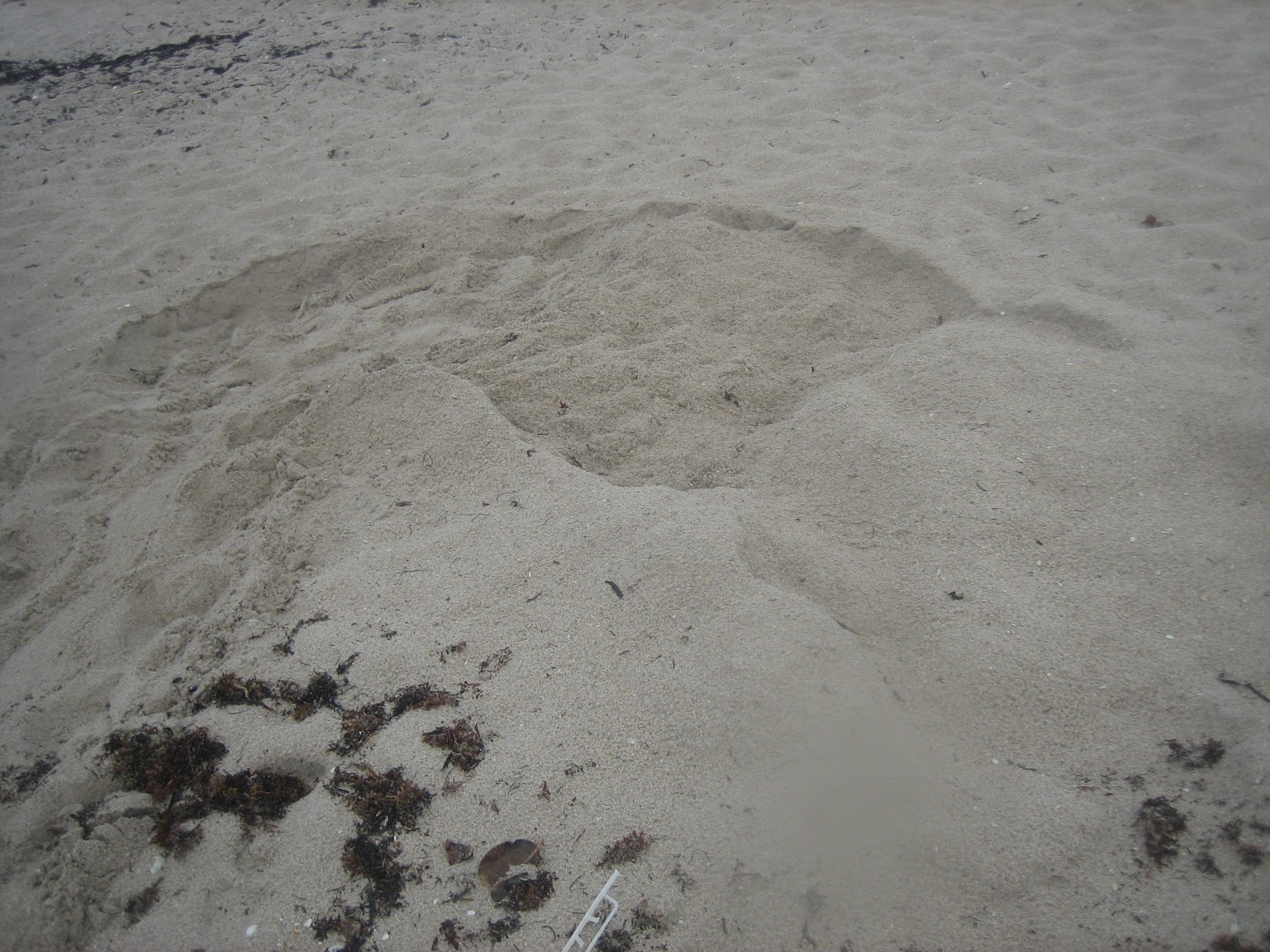
These ladies seem make HUGE nests with deep body pits, and often work their way well into the dune vegetation.  A variety of theories are out there as to why this occurs, including that turtle-momma might be nesting as far from the high tide line as possible to avoid her nest washing away during its 60+ day incubation.  Here in Florida, though, when up in the dune vegetation beware of FIRE ANTS. These invasive insects have been regularly documented killing hatchlings (baby turtles) by swarming nests.

Big turtle = BIG PIT
During my years of nesting surveys, I found green turtles occasionally spend so much time nesting (digging, laying eggs, and covering the evidence) that they were still on the beach after dawn.  This also led to me learning exactly how far those flippers actually spray sand while covering their nest.  I stood behind the lovely female below only to be knocked over by the sand blast!
The 3 stakes in front of this turtle mark a loggerhead nest laid that same night. The tracks from that nest are still visible.
Similar to loggerheads and hawksbills, green turtle eggs are roughly the size of a ping pong ball. Green nests are usually larger though, which makes sense as this is a much larger species of turtle. The average green turtle nest has 120 - 150 eggs, with my personal highest count being 174 eggs in one nest.

How big do greens get?  This particular species of turtle can easily grow anywhere from 250 - 400 lbs (110 - 190kg) on average. The largest green turtle documented was 5' long and 870 lbs.


How to identify a green from another species:  Green sea turtles are distinct in a few ways. When looking head-on, there is only one pair (i.e. 2 total) scales between the eyes. Most turtle species have two pair in that location.
The 2 Pre-frontal scales between the eyes are unique to green sea turtles
When looking at the carapace, or top shell, greens have four scutes on each side, and five down the middle.  Their shells may vary in color from green to yellow.  Their shells are usually clean, especially compared to loggerhead turtles; they are even documented on reefs at "cleaning stations" where fish or other symbiotic critters come out to help keep the turtle looking shiny.  Picture the "car wash" in the movie A Shark's Tale and you will get the basic, albeit far more musical, concept.

Juvenile Green Turtle - Carapace View
Green sea turtles are on the rise, but were once a critically endangered species here and in other parts of the world.  Why?  Think about it... this animal is named after the color of its meat.  That would be like referring to cows as "red" cattle.  Humans ate them, and in some areas and cultures still do.  The Cayman Turtle Farm in the Cayman Islands participates both in research and restaurants.  Sea turtles are a part of the lifestyle there; while I have never (and doubt I ever could) eaten turtle of any kind, I do have to slow down and understand that my culture is not the same for everyone.  I do eat meat.  Some humans have chosen a life as a vegetarian or even gone a step further as purist vegan.  No judgement, except on to-fur-key.  If you have never heard of it, good for you. Sorry, vegans. But I digress...
Turtle canneries went out of business long before sea turtles were added to the endangered species list in 1978.  This was due to overfishing practices.  Research and conservation efforts have been in full swing almost ever since.  The point is humans should take responsibility and always tackle feeding our race while keeping sustainability in mind.
Ouch! (I just twisted my ankle jumping off the soap box)

If there is some burning question you have about greens or any sea turtle species, feel free to ask! I'll be happy to share what I know as fact, or else I will find the right answer for you!

BONUS ROUND!

I consider myself lucky to have acquired many wonderful friends and colleagues over the years, and Cody Mott is no exception.  I have the honor of bragging that I knew him before completing his Bachelor's and Master's degrees, before his work at Inwater Research, and now even before his marriage to another awesome friend- Rebecca.  Cody's Master's thesis focused on one behavioral aspect of the green sea turtle.  While all sea turtles must orient themselves to reach the ocean as hatchlings, animals with large migration routes must also be capable of finding their way through a multitude of habitats without getting lost.  Cody worked closely with one aspect of green turtles and their ability to find direction using the sun as a compass.  Many of the behavioral studies on sea turtles focuses on the green.  This is because the general consensus among those working with marine turtles on a regular basis is that the green is the most intelligent among the lot.  They are usually the ones trained first in captive settings and personally, I find them the prettiest (sorry, hawksbills).  I am also aware that the last fact is completely unrelated, but thought you should know anyway!
Don't those eyes look intelligent to you?


Sun Compass Orientation in Juvenile Green Sea Turtles (Chelonia mydas)
CODY R. MOTT and MICHAEL SALMON
Department of Biological Sciences, Florida Atlantic University, Boca Raton, Florida 33431 USA
[codyrmott@hotmail.com; salmon@fau.edu]


ABSTRACT. – Juvenile green turtles occupy home ranges on shallow reefs that parallel the
southeastern coast of Florida. When disturbed, the turtles often flee eastward toward deeper water. We captured turtles at night and recorded their orientation during the next 2 days while they swam tethered inside a large circular outdoor pool and were exposed to the sun. The turtles from 2 reef sites were significantly oriented eastward. After 7–10 days of exposure to a laboratory photocycle advanced by 7 hours, turtles tested in the same pool were significantly oriented westward, the predicted direction if they used the sun for orientation. Westward orientation was unaffected by placing either disc magnets or brass discs of identical mass above the turtles’ heads. These results are consistent with the hypothesis that orientation under clear skies is preferentially based upon solar cues. However, control turtles exposed for 7–10 days to a photocycle advanced by 1 hour were also expected to swim generally eastward, but, for unknown reasons, failed to show significant orientation. Our results therefore support the hypothesis that the sun is used as a compass, but additional experiments will be required to provide definitive evidence.


To learn more about Cody's research, or to acquire the complete paper, contact him directly or contact myself through this blog and I will be happy to help.  He now works with a fantastic organization called Inwater Research Group. To learn more about their (and Cody's) current work, check out the website: http://www.inwater.org.

For general facts about sea turtles, to learn more about the conservation and research going on throughout the entire world, I highly recommend the following sites:
http://www.seaturtle.org/ or http://www.conserveturtles.org/ The latter was formerly the Caribbean Conservation Corporation and is most useful when looking into research done in that region of the world.  I hope this post has helped you get to know and love one of my favorite species just a little bit more!

Just keep swimming!
-Callie Sharkey

Sunday, July 22, 2012

Back on Turtle Beach


Like most Florida residents, I moved here from somewhere else - somewhere quite different. I didn't come here for the endless summer, but the sand and saltwater were directly related to my pilgrimage from the heart of the Bible belt to the east coast, the crust of the New World and the beginning of mine.

As a kid I was in awe of Shamu and inspired by every bleached out sea star in the gift shops of Hawaii.  I was fortunate enough to go there as an enthusiastic 11 yr old and nearly went blind on that 2 week trip, staring at the ocean horizon; not daring to blink lest I miss a humpback whale sighting. Even then I knew that April was past season and their migration to the cold waters of Alaska had already begun-  they were long gone.  Still, I stared endlessly and used my allowance money to buy a t-shirt with a very friendly sunglass-wearing humpback cheerfully displaying the false impression that I had actually seen a whale for myself 

Florida, despite its lack of humpback whales, was still the ocean and I jumped at the chance to move over 1500 miles from everyone and everything I knew just to be near it.  Following one opportunity to the next landed me working on the beach doing sea turtle research. This immersion commanded my attention both professionally and recreationally for nearly 10 years.  From nesting to rehabilitation, through live capture and necropsies on the dead, sea turtles has been so integrated in my life that I can honestly say, "been there, done that, got the tattoo." 

Last week I found myself back on the beach recently with another college buddy, Donna.  Scheduling conflicts and a toddler kept me off sea turtle nesting surveys (this year) but I was able to capture this moment and remember why I love the world of turtles and find the process of nesting surveys on the beach so restorative.  As an educator, it would be easy to carry on about sea turtles indefinitely, and anyone who has known me for more than 5 minutes would probably attest to that fact.  There will be more on turtles in the future on this pages, but today I want to talk about one day and one survey.

Sea turtles live in the ocean. That might seem like a silly thing to mention, but I have seen people trying to raise them in chlorinated swimming pools and release poor freshwater sliders on the beach.  Marine turtles have such rare contact with land that it can be pinpointed to just a few reasons:


Perfect loggerhead nest fresh from the previous night
1. They are born on the beach, but immediately go to the water if healthy
2.  Females return as close as possible to the beach of their birth to lay their own eggs
3.  Unfortunate turtles wash ashore when injured or seriously ill
4.  There are always exemptions found in nature. For instance, green sea turtles, both male and female, have been documented basking on the rocky shores in areas of Hawaii. Have NOT seen that on my excursions to the islands, but have seen plenty of pictures and spoken to scientists and witnesses about it.


Sea turtle nesting surveys require permitting, training, and getting dirty.  Since marine turtles are all protected by the Endangered Species Act, not just anyone can go running out on the beach at dawn and go digging around. The survey consists of 3 major situations: nests, false crawls (aka non-nesting emergence if you want to sound technical), and hatch outs.  The last involves the end of incubation when live hatchlings (baby turtles) emerge from the nest and head for the water. This particular survey did not have any new hatch outs.

Donna and I arrived on the beach prior to sunrise, but when the sun finally started to peek out from the clouds we had already been walking and rained on for awhile.  Years ago, prior to becoming pregnant with my now 3 yr old son, I dragged my "I am SO not a morning person" friend out on to a totally different beach at dawn to volunteer on a 2 mile stretch not far from this day's survey.  While walking along we chatted lightly about turtle work in the past and how our lives have shifted, yet here we are again, back on the beach tracking the trails left behind by living dinosaurs.  Awesome.  It was almost surreal this time, though, as she was the lead on this survey, instructing me on how this beach is run. The methods and tracking vary with permit, and it was very cool to be trained by someone that I had trained in the past.  Then Donna said perhaps the greatest compliment I have heard this year... she thanked me for introducing her to sea turtles.

Just like me, D finds the long beach walks cathartic and prime time for self-reflection.  Since conservation work is happening at the same time, one often walks away from the beach feeling productive on a professional and emotional level.  C'mon, it's such a great feeling to know you are doing something for the greater good of the planet and pardon my lofty enthusiasm, but saving the world one species at a time also provides those warm fuzzies which drive humans to do many great things.
This False Crawl is a direct result of the turtle hitting a large sea wall.
Okay, the warm fuzzies have officially cooled off and now here are some real facts about sea turtles for you to enjoy!  Of the 7 species of sea turtles found on this planet (many scientists discuss an 8th, the black sea turtle but that is a discussion that merits its own entry - so I am going with tradition and the Sea Turtle Conservancy on this one), 5 are found in or around Florida's coasts and 3 of those have significant nesting here: loggerhead (Caretta caretta), green (Chelonia mydas), and leatherback (Dermochelys coriacia). 


Textbook green sea turtle track

In Florida, the turtle nesting season technically runs from March 1 - Oct 31, but the height of season is June 1 - August 31. Donna and I were greeted by both loggerhead and green turtle crawls on this day.
Loggerhead crawls are characterized by comma-shaped tracks
Any time a sea turtle comes ashore and does not nest, it is considered a false crawl or non-nesting emergence and can happen for a variety of reasons. Something may have startled the turtle (human or otherwise), or maybe she just digs for a bit and simply doesn't like the quality of the sand and changes her mind - a woman's prerogative after all.

Green turtle tracks look very similar to large tractor tire tracks (see above) and generally range from about 3-4' across.  These mature ladies start at 300 lbs, so they are using all 4 flippers to hoist their bodies up the sand  The center line seen in the photo I took on this survey shows the tail dragging in the sand as she moved back to the water.

Loggerhead turtles are smaller and crawl very differently.  They have an alternating gate, like how human babies typically crawl around with one limb forward at a time.  The comma-shaped flipper marks are made by the back flippers, so the track pictured here is moving to the left. The back flipper track basically covers up the front track, which makes it easy to spot a "stumpy" turtle - one with a short or missing back flipper.  It happens, and while the egg chamber may look odd, these injured turtles can still have successful nests.
This loggerhead nested right next to a large stack of folding beach chairs, so we tri-staked the area to keep it from getting consistently trampled for the next 2 months.
In addition to marking new nests and taking notes of false crawls, we were keeping an eye out for hatched nests.  Roughly 60 days after the nest is laid, all of the eggs hatch and the baby turtles emerge from the nest as a group. This usually happens at night, so a mass of tangled tiny track marks can be seen the following day.  I do not suggest sitting next to a nest all night long exactly 60 days after it was laid in the hopes of seeing a natural hatch out.  I have personally spoken to people who had "been walking this beach for 40 years" and never seen one, and also a family from Indiana that had arrived the previous night/morning on a red eye flight, checked in to their hotel and walked out on to the beach to see the little critters everywhere.  It's like roulette, and all about luck.
I never get tired of beach work!... although I do smell pretty bad when I get home

Part of the survey includes excavations.  Digging up a hatched out nest yields extremely valuable scientific data. Loggerhead nests (what we dug this time) are usually about 2 feet deep overall and shaped like an upside down light bulb.  The hatchlings move around in the bowl portion and since you have 75 - 100 of them moving around down there, the sand packed into the shaft by momma breaks away and filters down under the babies.  This process slowly pushes everybody up in one chaotic group, but sometimes the dudes at the bottom of the pile get left behind, but don't worry - we find 'em later and set them free after taking complete inventory of the nest contents.
Excavation & inventory take place 3 days after hatch out to allow nature to take its own course
We finished the morning after 3+ hours with 3 loggerhead nests, 1 green nest, and a couple of loggerhead false crawls. We excavated 2 loggerhead nests, and ended up with 7 live guys that all went to the ocean quickly. Not a crazy day considering this is a record nesting season for loggerhead turtles across the state, but no nests washed away, no poaching, and no natural predators destroying nests so I would still call it a productive and positive day for turtles.

Happy Birthday! to this little loggerhead hatchling
Since my passion for sea turtles does run so deep, expect to see plenty of photos from past excursions emerge on to the blog.  Going back out for one morning reminded me of how amazing the experiences have been, and that I documented so many of them with photos and videos!

Even if its raining, don't be afraid to go to the beach.  At least it won't be crowded! (now, lightning is a different story and use that big beautiful brain of yours when it comes to playing safe) Dig through those old photos and take a moment to reminisce about those adventures that truly shaped your life.

And, if you aren't sick of sea turtles yet... stay tuned!
-Callie

Monday, July 16, 2012

Jellyfish Bio 101: Local Identification, Local Research

When approaching the final few semesters of college, I began to lament the fact that I didn't have that typical group of "College Buddies" like those so important to the plot lines in a generic comedic movie. Very few of my family members actually went to college, so I knew people with "High School Buddies" and still have several of those myself - but the feeling that I had missed out on some beautiful part of the college experience was looming in the rafters.

Then, I seized the opportunity to live, eat, and breathe marine science at one of the most ground breaking facilities in the world with a group of 9 other similarly minded individuals as part of the Semester by the Sea program at the Harbor Branch Oceanographic Institute. While I could easily blog for a year about the adventures and experiences had during that pivotal time in my education (and when I find those photos I will do just that!), I would like to focus on one specific colleage, Evan Orellana. We learned to surf together, although he pursued it with passion and I plateaued quickly, and I consider him a life-long "college buddy" for sure.

Evan, without the promises of post-graduate bliss, also championed his own research on one of the local invasive species - the Tripedalia cystophora species of box jellyfish.  The box jellyfish is famous for A) having an extremely painful sting and B) being found in Australia.  There are actually several different species in the Cubozoa family, and 3... well, now 4 are found here in south Florida.
This newest invader is only one of several species of box jellies
So, today is a quick lesson on jellyfish.  This post will cover many species found here in south Florida but also provide information on the jellyfish life cycle, and perhaps more interestingly how they sting.  Yes, there will also be notes on what to do when stung by various types of jellies ranging from sea lice to the Portuguese man o' war.  The photos included in this segment come straight from the scientist buddy mentioned before, Evan Orellana, from his exceptional presention that he has already given at a variety of venues.  We have deemed him "the Jelly Man" as a tribute from the awesome title given to Marlin in Finding Nemo after he cleared a serious jellyfish bloom.

Jellyfish Biology 101: 
Disclaimer - These facts are the basics and a generalization of jellyfish species.  This will help you understand what you see in the water and on the beach. While well researched and accurate, I do not recommend this as a short cut for writing your own biology paper. If you are a biology major or want to know the real details about Evan's research, additional information about the paper can be found at the end of the blog post. Now that portion is something you can reference with your research papers, but please be sure to give credit where it is due and not refer to this blog as the original publication. To see his abstract jump to http://journals.cambridge.org/action/displayAbstract?fromPage=online&aid=8310371&fulltextType=RA&fileId=S1755267211000133

On to the fun!
The jellyfish is not actually a fish. These invertebrates are generally characterized by a dome shaped "bell" and tentacles bearing stinging nematocyst. They are an ancient species with evidence in the fossil record dating back to the Cambrian era (570-505 million years ago).  The "medusa" is a stage in the jellyfish life cycle, and the first image brought to mind when you think "jellyfish".
Jellies use both asexual and sexual reproduction - smart move for an animal with no brain.
To put the above diagram in basic terms, jellyfish start out as polyps, very similar to corals.  They "bud" off into a floating form that eventually grows into the medusa we all recognize. The second reproductive stage yields planktonic planula that settle on a substrate (ideally a sold location like a rock) and then grow into a polyp. Cool, huh? Way simpler than that frog life cycle you had to learn back in high school bio.
The infamous stinging portion of a jellyfish is called the "nematocyst" and is located on the tentacles. These are used for capturing prey like tiny fish. Since jellyfish are so delicate, paralyzing their food is essential to avoid being torn up while trying to eat dinner.  The above diagram shows the stinging cells coiled up inside the nematocyst. When triggered, usually by contact, the nematocyst fires and shoots the thread out where it attaches to the victim.

This view of a tentacle up close shows thousands of tiny dots crammed into the larger casing. Think of it as yarn when bound up tightly, making it nice and compact while allowing for easy access.
The second close-up hones in on individual nematocysts, and the coiled up threads are still very active and waiting to fire.  This is why finding a jellyfish on the beach, live or dead, can be able to sting! Those cells are still under tension and will fire upon contact.

HINT: Don't pick up a jellyfish when it washes ashore just to show your friends or family. Walk them over to where you found it and just point. Plus, now they will know what to avoid while on a nice beach walk.


So, what does one do when stung? Going back to basic chemistry, think of how acids and bases can neutralize each other.  To offset the burning from a jellyfish sting, here are the most common treatments and why they work (or maybe don't):
1. Ammonia is weak base (11.6 on the pH scale), and it is also what gives cat urine that oh-so identifiable stench. Many are told to pee on a jellyfish sting, but this is not usually very affective.
2. Vinegar is a very strong acetic acid, so it doesn't burn skin. With a pH of around 2.4, vinegar is acidic enough to neutralize the jellyfish venom. Yay! And it still smells better than pee. I have learned from personal experience that the type of vinegar doesn't seem to matter; this includes using the vinegar condiments right off the table at a BBQ place in the keys - still worked!
3. Perhaps the WORST thing you can do is douse the sting in COLD FRESHwater. This causes any nematocysts still on the skin to fire like crazy. Saltwater will not make the stingers release, but this also does not help with the pain if you have already been stung. HOT or very warm freshwater does do the trick. When snorkeling virtually everyday, we would place a large jug of tap water on the beach; by the time we exited the water, it was nice and toasty.  Rinsing off with this water relieved my husband's jellyfish stings (usually man o' war, sea lice, or moon jelly) but prevented any outbreaks from sea lice when washing off at the cold freshwater stations near the bathrooms.
NOTE: Individuals may react quite differently to jellyfish stings depending on the severity and quantity. Serious allergic reactions may occur.  Tell-tale signs include tightness of chest and/or shortness of breath. In this case, call 9-1-1. Simple topical treatment of the whelps will not be enough.  If there is swelling and pain, but no trouble breathing, just calm down.  Boat captains/dive masters and lifeguards deal with this everyday and should be perfectly capable of helping.

Years ago, a friend in the Florida Keys had a very sweet mutt that she would take to the beach.  One such visit resulted in her poor little dog getting wrapped up in a Portuguese man-o-war and the tentacles became very tangled in its fur. She rushed her dog to the vet where they gave steroid shots and diphenhydramine (benadryl/major ingredient in anti-allergy meds and tylenol pm as a sleep aid).  After waking that evening, the dog started shrieking and her owner repeated the process. At work the following day she was in tears and at a loss on what to do. "Give her a vinegar bath, just use the cheap stuff", I advised. Sure enough, she returned home and quickly had a very happy and pain free dog (although the smell of wet dog and salad dressing seems like olfactory overload to me).
Jellyfish are amazing and found world wide. They are microscopic but also over 20 feet long, can be found in the deep ocean with striking bioluminescence and even reside in freshwater coves.  It would be easy to spend a career striving to understand and appreciate the diversity of these animals, but this snap shot of identifications will at least help improve your beach walk and snorkeling on the east coast of Florida.
True jellies are Cnidarians (phylum). Locally some of the most common species are pictured below. Just check out the caption for identification:
Upside down jellyfish (discussed further in the 7/12 blog posting)
The Moon Jelly is extremely common and quite beautiful in the water.


Moon Jellyfish often wash ashore and can still sting despite the short tentacles

True Jellyfish are Scyphozoans

The thimble jellyfish is more commonly known as "sea lice"

Sea lice is actually the thimble jellyfish. This true jelly is very common in our waters, and it is the smaller medusa stage in the life cycle (see diagram noted earlier) before the animal reaches sexual maturity that has the uncanny ability to sting all along the edges of one's swimsuit. The thimble jelly is one of the 4 different species of box jellyfish found in Florida waters now. Just look at the box-like shape of its body to figure why it is considered a Cubozoan.
A "true" jelly is defined by how it buds off from the polyp.  While in this phase of reproduction, true jellyfish are stacked on top of each other like miniature stinging pancakes and the animal at the top of the stack is released in succession.


The fabulous and colorful comb jelly has no stinging nematocysts. They are Ctenophores, not Cnidarians
Also not "true" jellies, these species are generally harmless to humans. Their stinging cells are usually not strong enough to break through the skin... Man-o-War EXCLUDED of course.
When on the beach, check out the conditions board before crossing the dune. If jellies have been washing ashore in significant quantities, a warning should be posted. Also look at the lifeguard tower's flags - PURPLE flag = jellyfish sighted that day in the area.  While walking along, particularly after a night of rough seas, there will probably be all sorts of cool things washed up with the sea weed.  Sometimes large wads of "sea snot" might be mistaken for a jellyfish. When in doubt, don't pick it up; but if you still are willing to take the risk, the ball of clear gelatinous goo that has no tentacles, striations or body structure is actually the feeding sack of a tube worm. These little critters create sticky snot-like balloons to catch bits of plankton and algae for the worm to eat without having to leave the safety of its hole. These balloons get tattered and break away, or the worm might just release them as a quick clean up when the in-laws are coming to visit unannounced. They have no nematocysts and cannot harm humans... unless you tried to eat one, but then maybe that person should get nauseated. This last bit of information is speculation. NO WAY am I gonna test that theory and neither should your toddler.

Not all creatures are susceptible to the jelly's sting. Sea turtles, for instance, are one of many ocean dwellers that use jellyfish as a major food source. While all species of sea turtle will eat jellies, they are the primary food source for the leatherback in particular. So the largest of all marine turtles, often weighing up to 1,000 lbs, survives solely on an animal that mostly water (95-98% depending on the resource)!

Another term commonly attached to the jellyfish, particularly in the media, is the "bloom".  Many different species of jellyfish are known to suddenly aggregate in abnormally high densities. This can be caused by removing the major predators in an area (leatherback turtles, for instance, are critically endangered) but also by environmental changes such as nutrient run off from the land into the sea, or by significant climate changes. Higher ocean temperatures have also been correlated to large jellyfish blooms in areas like the Gulf of Mexico.


Okay, the following is the abstract to Evan Orellana's actual published work. The topic of invasive species are finally gaining some general public interest, but the realization that exotics often end up in the wrong ecosystem without having been introduced as a pet (i.e. pythons in the Everglades) has not quite set in.  Marine exotics are a particular problem because all life on earth needs water, and when the balance of health is compromised starting with the water resources for an environment, serious problems may take hold quickly and be extremely difficult to control.  Prior to Orellana's findings, only 3 species of Cubozoans (box jellyfish) were found in south Florida; the addtion of a 4th is significant.  Even now this species is being spotted further north in Florida, so his research continues and we will follow his work closely.  (I did have some formatting issues while transferring the pdf into this post. While all of the information is verbatim, I might have missed some italicizes here and there. My apologies) Enjoy!

First report of the box jellyfish  Tripedalia cystophora (Cubozoa: Tripedaliidae) in the continental USA, from Lake Wyman, Boca Raton, Florida
http://journals.cambridge.org/action/displayAbstract?aid=8310371">http://journals.cambridge.org/action/displayAbstract?aid=8310371
>

Marine Biodiversity Records, page 1 of 3. # Marine Biological Association of the United Kingdom, 2011  doi:10.1017/S1755267211000133; Vol. 4; e54; 2011 Published online
First report of the box jellyfish Tripedalia cystophora (Cubozoa: Tripedaliidae) in the continental USA, from Lake Wyman, Boca Raton, Florida


EVAN R. ORELLANA AND ALLEN G. COLLINS
Gumbo Limbo Nature Centre, 1801 North Ocean Boulevard, Boca Raton, FL 33432, USA, 2NMFS, National Systematics Laboratory, National Museum of Natural History, MRC-153, Smithsonian Institution, PO Box 37012, Washington, DC 20013-7012, USA

ABSTRACT
A male specimen of Tripedalia cystophora (Cubozoa: Tripedaliidae) was collected from Lake Wyman, Boca Raton, Florida, USA. This is the first report of this species from the continental United States and brings the total known number of cubozoan species living in this region to four. Lake Wyman is a natural lagoon/estuary ecosystem which is part of the Atlantic Intracoastal Waterway. The box jellyfish was found in shallow water around the roots of the red mangrove, Rhizophora mangle, where it was observed feeding on copepods attracted to light. This finding may indicate a local population in the waters of south Florida, USA, but an isolated occurrence cannot be ruled out.
Keywords: Cubomedusae
Submitted 5 May 2010; accepted 21 January 2011

A.


REFERENCES
Bentlage B., Cartwright P., Yanagihara A.A., Lewis C., Richards G.S. and Collins A.G. (2010) Evolution of box jellyfish (Cnidaria: Cubozoa), a group of highly toxic invertebrates. Proceedings of the Royal Society B 277, 493–501.
Calder D.R. (2009) Cubozoan and scyphozoan jellyfishes of the Carolinian biogeographic province, southeastern USA. Department of Natural History, Royal Ontario Museum, Toronto, ON, Canada.
Coates M.M. (2003) Visual ecology and functional morphology of Cubozoa (Cnidaria). Integrative and Comparative Biology 43, 542–548.
Collins A.G., Bentlage B., Gillan W., Lynn T.H., Morandini A.C. and Marques A.C. (2011) Naming the Bonaire banded box jelly, Tamoya ohboy, n. sp. (Cnidaria: Cubozoa: Carybdeida: Tamoyidae). Zootaxa 2753, 53–68.
Conant F.S. (1897) Notes on the Cubomedusae. Johns Hopkins University Circulars 132, 8–10.
Daly M., Brugler M.R., Cartwright P., Collins A.G., Dawson M.N., France S.C., McFadden C.S., Opresko D.M., Rodriguez E., Romano S. and Stake J. (2007) The Phylum Cnidaria: a review of phylogenetic patterns and diversity 300 years after Linnaeus. Zootaxa 1668, 127–182.
Gershwin L.A. (2005) Taxonomy and phylogeny of Australian Cubozoa. PhD thesis. School of Marine Biology and Aquaculture, James Cook University, Townsville, Queensland, Australia.
Migotto A.E., Marques A.C., Morandini A.C. and Silveira F.L. da (2002) Checklist of the Cnidaria Medusozoa of Brazil. Biota Neotropica 21–31. http://www.biotaneotropica.org.br
Nilsson D.E., Gislen L., Coates M.M., Skogh C. and Garm A. (2005) Advanced optics in a jellyfish eye. Nature 435, 201–205.
O¨stman C. (2000) A guideline to nematocyst nomenclature and classification, and some notes on the systematic value of nematocysts. Scientia Marina 64, Supplement 1, 31–46. Stewart S. (1996) Field behavior of Tripedalia cystophora (Class Cubozoa). Marine and Freshwater Behaviour and Physiology 27, 175–188.

and
Werner B. (1973) Spermatozeugmen und Paarungsverhalten bei Tripedalia cystophora (Cubomedusae). Spermatozeugmata and mating behavior in Tripedalia cystophora (Cubomedusae). Marine Biology 18, 212–217. [In German, with English abstract.]Correspondence should be addressed to:
E.R. Orellana
Gumbo Limbo Nature Centre
1801 North Ocean Boulevard
Boca Raton
FL 33432, USA
email: e_orellan@hotmail.com